
Why Physical AI is becoming the next frontier
Insights from the AI Conference 2026 Heidelberg
Over the past few years, progress in artificial intelligence has been nothing short of remarkable. Foundation models have grown rapidly in scale and capability, compute has become more accessible, and AI systems now excel at interpreting text, images, and speech.
And yet, a recurring theme emerged throughout the discussions and keynotes at the AI Conference Heidelberg: despite these advances, AI still struggles when it comes to understanding and reliably interacting with the physical world.
This gap is not incidental. It points to a structural limitation of today’s AI systems - and to why Physical AI is increasingly moving into focus.
The limitation is not intelligence - it is reality
Most state-of-the-art AI systems are trained on vast amounts of digital data. They learn from representations of the world: text, images, videos, simulations. This works exceptionally well in domains where reality can be abstracted, labeled, and replayed.
Physical systems, however, behave differently.
They are continuous, noisy, and often unpredictable. Critical changes happen gradually, and failures rarely announce themselves clearly in advance. In many industrial and energy systems, the most important signals are neither visible nor easily inferred.
One fundamental challenge stood out in many of the discussions around AI: advancing reasoning capabilities alone does not automatically translate into a deeper understanding of real-world physical systems. And in physical systems, feeling is often more important than seeing.
Physical AI exposes internal system dynamics beyond visual observation.
The real bottleneck: physical data, not algorithms
It is tempting to assume that better models alone will eventually solve this problem. But many discussions at the conference converged on a different conclusion: the bottleneck for Physical AI is not primarily algorithmic.
It is data.
Specifically, high-quality, continuous, real-world physical data.
Most physical systems today are under-instrumented. Measurements are often indirect, infrequent, or taken only at a system boundary. As a result, AI models are asked to infer internal states from limited or delayed information. This makes learning slow, brittle, and hard to validate.
Without direct access to physical signals - such as pressure, temperature, forces, or leakage at critical points - even the most advanced models remain partially blind.
Physical AI therefore starts not with smarter algorithms, but with better access to the physical world itself.

FLEXOO frames the challenge as the data‑to‑action gap - the distance between sensing something in the real world and turning it into the right action fast enough to matter.
From interpretation to interaction
A second shift that became evident at the AI Conference Heidelberg is the growing importance of interaction.
AI systems are increasingly expected not only to interpret data, but to influence real processes: regulating systems, triggering responses, and closing control loops in real time. In these contexts, latency, robustness, and reliability matter just as much as accuracy.
Once AI begins to interact with physical systems, the role of sensing changes fundamentally. Printed sensors are no longer peripheral components; they become the primary interface between AI and reality.
This again highlights why feeling matters more than seeing: many decisive changes in physical systems occur long before they become visible or catastrophic. Early signals are subtle, internal, and often only accessible through direct physical measurement.
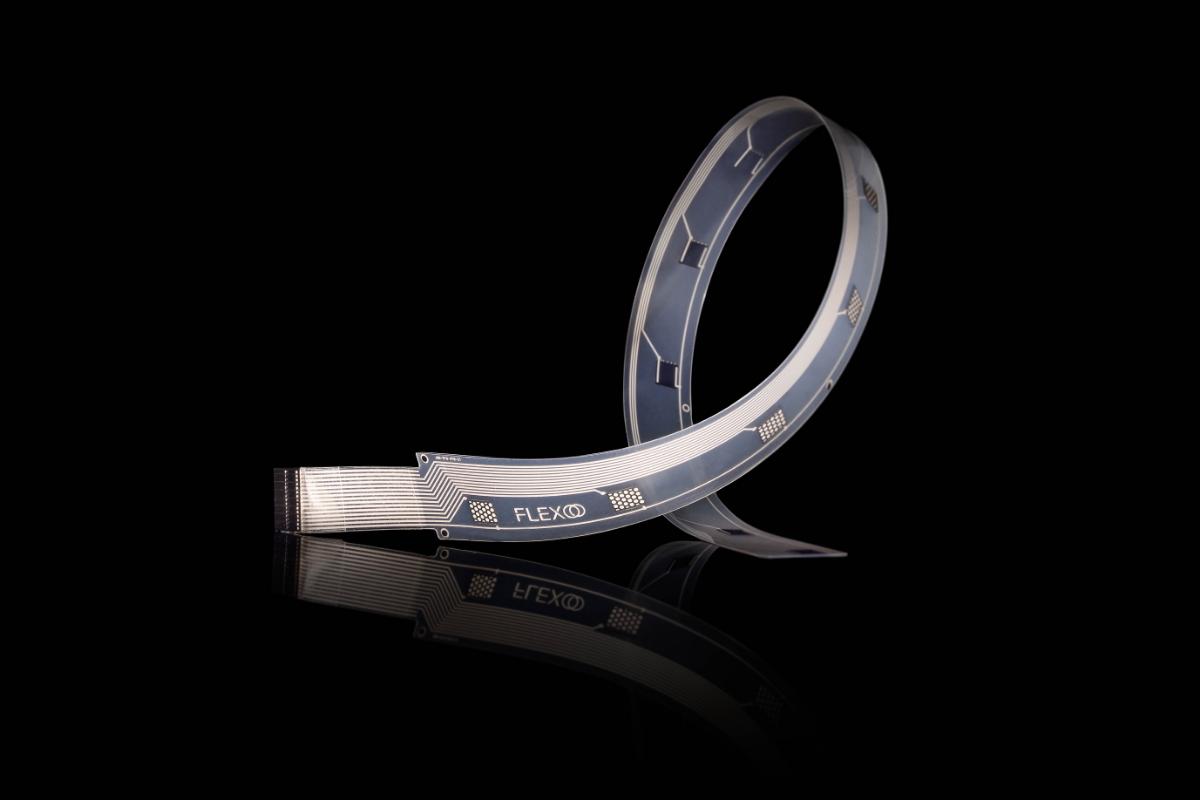
Everything starts at the contact surface. If you want machines to act in milliseconds, you need sensors where the physics happens.
Physical AI as an emerging category
Taken together, these observations point to the emergence of Physical AI as a distinct category.
Physical AI systems are characterized by:
- Direct access to real-world physical signals,
- Continuous data generation under operating conditions,
- Learning loops that connect sensing, data, models, and action,
- And deployment close to the system, where decisions actually matter.
Importantly, Physical AI is not a new label for existing AI workloads. It is a response to a structural limitation: the inability of purely digital approaches to reliably model and manage physical processes without grounded, physical data.
This is why domains such as energy systems, industrial machinery, and robotics are natural early adopters. They are data-critical, safety-relevant, and governed by physical dynamics that cannot be abstracted away.
Why now?
The timing of this shift is not accidental.
Compute is abundant. Models are powerful. Tools and infrastructure have matured. At the same time, industrial systems face growing pressure: higher efficiency requirements, tighter safety margins, and increasing operational complexity.
In this environment, the next leap in AI will not come from larger models alone. It will come from systems that can feel the world they operate in - and learn from it continuously.
Physical AI is not a vision of the distant future. It is the logical next step when artificial intelligence meets physical reality.
Let’s start to work on your challenge!
Ready to take the next step? Reach out to our sales team today and discover how we can tailor our solutions to meet your needs.
Talk to our experts!
Have a specific application, challenge, or project in mind? Schedule a meeting with our team to discuss your requirements and explore potential next steps.