
Tactile first: A radically new Physical AI
The most critical moments in physical systems are invisible. They live in pressure, friction , and contact - not in images or simulations. Physical AI built on tactile data perceives the world from physical ground states, not from imitation.
The core problem: the data‑to‑action gap
When AI moves beyond digital environments and into real systems, it faces a fundamental limitation: It cannot access the data it needs to act.
This creates the data‑to‑action gap: The distance between what is physically happening and what a system can respond to in real time.
Critical system behavior is not visible
In physical systems, what matters most happens inside -
under load, at contact surfaces, and in real operating conditions.
These changes begin long before anything is visible to the eye.
The most relevant signals are not measures
Sensors are often not placed where these changes occur.
Key signals such as pressure, temperature, and early-stage leakage remain untapped.
As a result, the actual state of the system is only partially known.
AI is forced to infer instead of respond
Without direct access to physical data, AI must approximate system behavior.
It does not perceive reality - it estimates it.
From interpretation to interaction
Most AI systems today are designed to interpret data not in realtime. In physical systems, this is not enough.
- In real environments, outcomes depend on timing, feedback, and control.
- A result that arrives too late - or without context - has no value.
- AI must therefore move beyond reasoning.
- It must act in realtime.
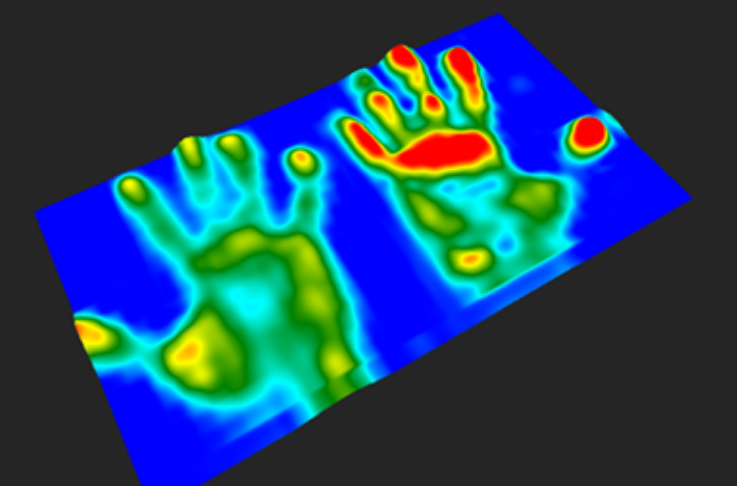
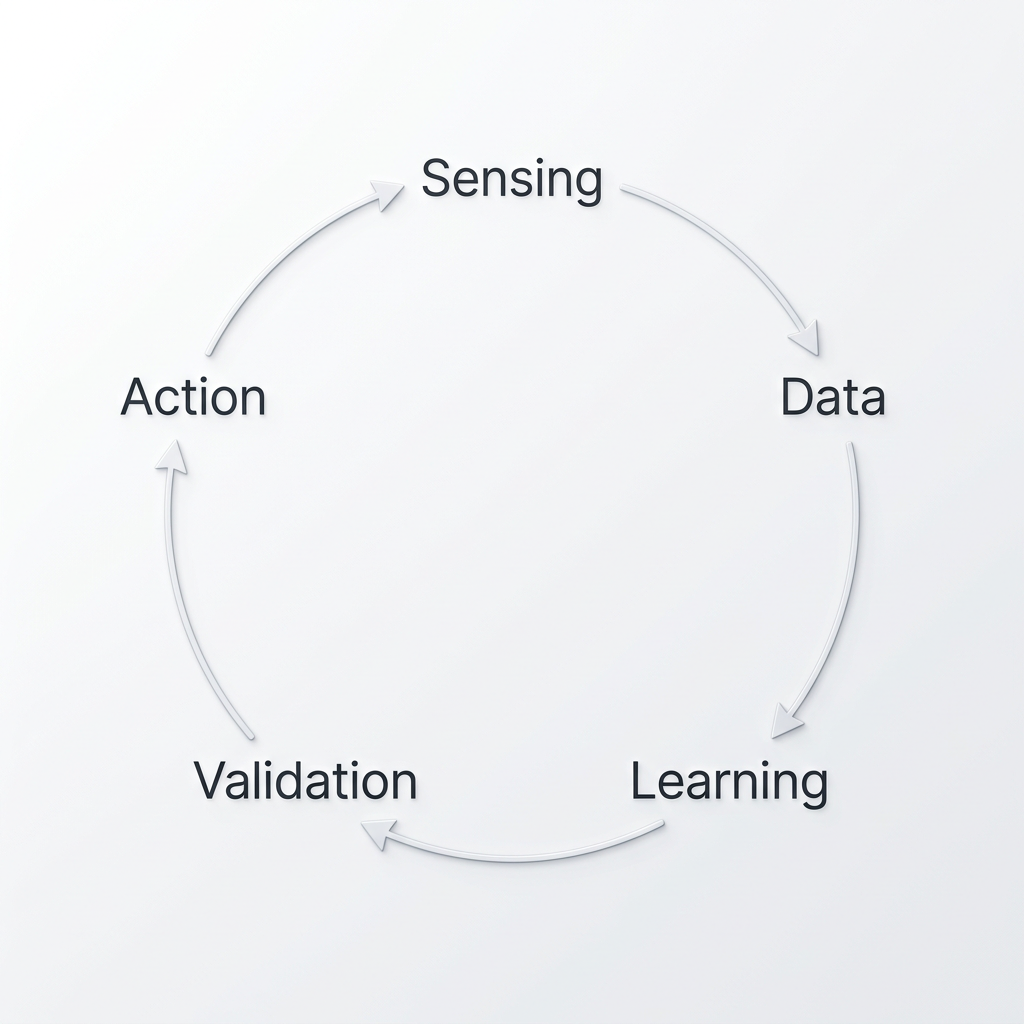
Physical AI connects sensing, data, and action into a continuous loop: Sensing → Data → Learning → Validation → Action
Each step happens close to where the system operates -and feeds directly into the next. This changes the role of AI fundamentally:
- From observation to participation
- From reasoning to response
- From analysis to system control
AI is no longer separate from the system. It becomes part of its behavior. Physical AI marks the transition from AI that interprets the world to AI that can interact with - and act within - real physical systems.
How Physical AI becomes possible
Physical AI does not start with models. It starts with access to real physical data. This requires a reliable physical data layer - connecting sensing, data capturing, and system response.
1. Data must be captured where physics happens
Physical AI requires direct access to physical signals - inside systems, at contact surfaces, and under real operating conditions.
This is where critical system behavior originates.
2. Data must come from real operation, not abstraction
Simulations and indirect measurements are not sufficient.
Learning systems require data generated in real environments - where physical processes evolve over time.
3. Data must enable validation, not just prediction
Physical AI depends on the ability to test and verify outcomes in real systems.
Only when data reflects actual system behavior can learning, validation, and action be meaningfully connected.
How FLEXOO enables Physical AI
FLEXOO enables Physical AI by industrializing physical data capture and delivering model‑ready datasets.
Instead of relying on indirect observation and imitation learning simulations, FLEXOO creates direct access to reliable physical data layers, where critical system behavior occurs. This includes data generated at contact surfaces, within materials, and under real operating conditions.
This physical data layer enables:
- learning based on real system behavior
- validation within operating environments
- closed-loop interaction between sensing and action
FLEXOO does not build isolated sensors - it provides the foundation on which Physical AI systems can operate.
FLEXOO enables Physical AI by turning physical interaction into measurable, actionable data.
Industrializing physical data capture
Making physical data accessible is not only a sensing challenge. It is a challenge of access, integration, and scale. FLEXOO addresses all three. This transforms isolated measurements into a scalable physical data layer - enabling Physical AI beyond individual use cases.
Access: Capturing data where it originates
FLEXOO enables sensing at previously inaccessible points - inside components, at contact surfaces, and within constrained system environments.
This brings data closer to where physical behavior actually emerges.
Integration: Making sensing part of the system
Sensors are designed to adapt to material requirements, device architectures, and system constraints.
This allows sensing to become an integral part of the system - not an external observation layer.
Scale: Turning signals into usable data streams
Physical data only becomes valuable when it is continuous, multimodal, and scalable.
FLEXOO enables the capture of multiple physical parameters - and makes these data streams available reliably and at industrial scale.
Where Physical AI becomes tangible
Physical AI is not a future concept. It is already becoming visible in systems where critical behavior cannot be observed - but must be sensed.
Robotics and energy systems are among the first domains where this shift becomes unavoidable. These are early domains and proofpoints - not the limit of Physical AI. They highlight a broader shift: from systems that are observed from the outside to systems that can be understood from within.
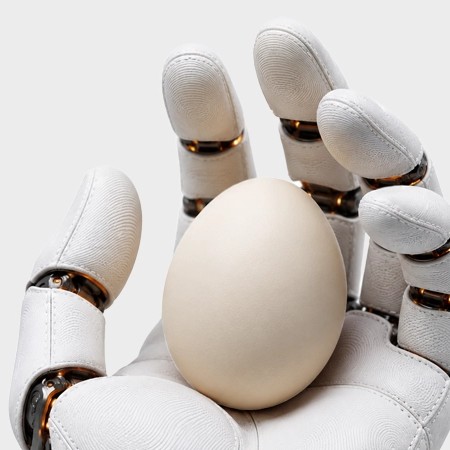
In robotics, interaction defines everything. Grasping, handling, and manipulation depend on contact, force, and timing in milliseconds - dexterity is not possible with vision systems.
What a system needs to know is not only where an object is, but what happens at the moment of contact.
Without tactile sensing, this remains invisible. With it, systems can begin to adjust, respond, and operate in real time.
In battery systems, the most critical processes cannot be observed from the outside. There is no camera inside a cell.
Pressure builds up, temperature gradients shift, and degradation begins internally - long before any external signal appears.
Without direct access to these dynamics, AI has no reliable basis for understanding system state. Physical sensing makes these internal processes measurable - creating the foundation for safety, performance, and control.
Ecosystem and collaboration
Physical AI requires more than sensing or models in isolation. It emerges when data, learning, and real-world application are continuously connected.
FLEXOO builds and operates this connection as a multi-layer system:
1. Physical data generation in real systems
Sensorized systems capture physical signals directly in operating environments - at the point where system behavior originates.
This creates continuous access to real-world physical data under actual conditions.
2. Domain models grounded in physics
On top of this data, models are developed that reflect real physical behavior - not only statistical patterns.
These models incorporate the dynamics of physical interaction and enable learning from real system states.
3. Deployment and validation in real environments
Deployed directly in application environments, where sensing, data, and decision-making operate as one integrated system. AI runs inside the system - in real time and without relying on distant infrastructure.
Sensor, model, and inference are no longer separate layers. They are combined at the point of action, where system behavior can be continuously observed and acted upon.
This approach is shaped through collaboration with selected partners.
This approach is shaped through collaboration with early partners, including:


Why Physical AI matters now
The next leap in AI will not come from scaling models - but from grounding them in physical data.
AI systems have reached a high level of capability in digital domains. Models are increasingly powerful, compute is available, and infrastructure has matured. At the same time, physical systems are becoming more complex, more dynamic, and more constrained.
In these systems, critical decisions depend on conditions that are:
- not visible
- not measured
- and not represented in existing data
This creates a growing gap between what AI can process and what it needs to understand in order to act reliably.
Bridging this gap requires a new layer of access to the physical world.
This is where Physical AI begins.
Physical AI is not a distant vision. It is the next step as artificial intelligence moves from digital abstraction into real-world systems.
Frequently Asked Questions
1. How do you work with partners on Physical AI projects?
We follow a structured approach to bring Physical AI into real systems:
1. Define the system and requirements: Together with our partners, we identify where system behavior is not yet visible or measurable.
2. Identify the relevant physical signals: We define which signals (e.g. pressure, temperature, force) are required to understand the system.
3. Build the physical data layer: Sensors are integrated to capture these signals directly under real operating conditions.
4. Train and validate Physical AI models: Models are developed based on real system data and tested against actual system behavior.
5. Deploy in real environments: The system is implemented and validated within the partner environment, enabling realtime interaction.
2. When is Physical AI relevant for a system?
Physical AI becomes relevant when critical system behavior:
- is not visible from the outside
- cannot be captured with existing sensors
- or requires real‑time response under changing conditions
In these cases, AI based on vision reaches its limits.
3. What makes Physical AI different from existing AI approaches?
Most AI systems rely on data that is:
- externally observable
- simulated
- or derived indirectly
Physical AI, in contrast, is built on direct measurements of real system behavior.
This allows systems not only to interpret data, but to respond to what is physically happening in realtime.
4. What types of systems can benefit from Physical AI?
Physical AI is particularly relevant in systems where:
- interactions happen under load, pressure, or friction
- internal conditions change dynamically
- small deviations can have large consequences
Examples include industrial automation, robotics, and energy systems - but the scope extends far beyond these domains.
Follow the beginning of Physical AI
Physical AI is only just beginning to take shape. As systems move from observation to interaction, new questions, applications, and approaches continue to emerge.
Explore our latest insights on Physical AI. Follow how this field evolves across research, industry, and application.

FLEXOO partners with DFKI: What does it mean for Physical AI?
FLEXOO enters collaboration with Siemens on Physical AI for industrial systems

FLEXOO and SmartFactory-KL extend partnership to advance Physical AI

When AI needs to feel the physical world
Get in contact with us!
Talk to our experts!
Have a specific application, challenge, or project in mind? Schedule a meeting with our team to discuss your requirements and explore potential next steps.